Showing posts with label Ebbets Field. Show all posts

Thursday, July 24, 2014

Vin Scully, on BYO Musical Instrument Night at Ebbets Field

We don't get TWC at SoSG Worldwide Headquarters, so we apologize for the lack of new Vin transcriptions this season. But we've dipped into the archives (OK, last year's games) to bring you some fresh transcriptions we haven't run yet.

Vin Scully, from the sixth inning of the Mets-Dodgers game on August 13, 2013:

It was memorable to have a chance of working in Ebbets Field. It was a delightful place.

On this day in 1951, for several years, the Dodgers had a group of fans who had musical instruments. They didn't play 'em well, but they had instruments. They were called the Dodgers Sym-phony.

Well, the local labor union decided the Dodgers had to pay this group, this motley group of players. Pay them. And of course they weren't going to do that.

So we'll tell you what happened, but we don't want to miss a pitch down here. And we'll get back to Ebbets Field after this.

So the Dodgers decided, Well, we're certainly not going to pay a bunch of fellows who are kidding around with musical instruments. So let's send 'em off, and we'll have a night dedicated to amateur musicians.

And if you bring an instrument, you don't have to know how to play it. But if you bring the instrument to the ballpark, you can come on in.

And several thousand people came with every imaginable thing that you can imagine. Violins and saxophones, harmonicas, trumpets. And you can imagine the noise was like nothing you have ever heard anywhere — and I wouldn't wish you to hear the noise anywhere.

One man drove up, tongue in cheek, I'm sure, with a flatbed truck and a piano. Said, "Can I come in?"

And they said, "If you can move the piano, you can come in."

Fly ball, Schumaker is out there, one away.

Well that was Music Depreciation Night at Ebbets Field back in 1951.

And the batter, Daniel Murphy, who singled to left, flied to center....

Monday, July 14, 2014

Vin Scully, on Second-Guessers

We don't get TWC at SoSG Worldwide Headquarters, so we apologize for the lack of new Vin transcriptions this season. But we've dipped into the archives (OK, last year's games) to bring you some fresh transcriptions we haven't run yet.

Charlie Dressen.

Vin Scully, from the sixth inning of the Yankees-Dodgers game on July 30, 2013:

We were skimming the cream on some of the World Series between the Dodgers and Yankees. 1953, that was the year of Billy Martin.

Billy Martin had four hits in the first game, he had twelve hits overall, hit .500 in the World Series. Carl Erskine struck out fourteen in a game the Dodgers won at Ebbets Field, but Mantle crushed a grand slam off Russ Meyer, and the Yankees won that one.

I think I told it before. Dodgers were playing the Milwaukee Braves. Bases were loaded, Russ Meyer was the pitcher. Fellow named Harry Hanebrink came up for the Braves and doubled home everybody and the Braves pulled out the game.

Little ground ball, they will get one but that's all. Two out.

Anyway, Charlie Dressen was asked by a Milwaukee writer, "Don't you think you had your outfield playing wrong?"

And Charlie exploded. You can imagine, you'd just given up a game-winning double in a game you think you'd won, and a fellow asks you, Don't you think your outfield was playing wrong.

That year, in 1953, Mickey Mantle came up. They brought in Russ Meyer because he had a good screwball, right? And Mantle took out four rows of seats in the upper deck in center field in Ebbets Field. Grand slam home run. Dodgers lose.

There's a telegram for Charlie Dressen, on his desk. It says i still think you're playing your outfield wrong. Oho! Talk about an arrow to the heart.

Andre Ethier, facing that public enemy number one from Andy Pettitte, the big curveball....

Monday, July 08, 2013

Vin Scully, on Batting Out of Order

Vin Scully, from yesterday's telecast:

Pablo Sandoval the batter. You know, the Giants had a first-inning mess-up yesterday, when Posey and Sandoval — actually, it was Posey who hit out of turn.

Sandoval, who was supposed to hit, was then declared out. Posey, who had doubled in a run, then had to come back up a second time, flied out for the third out and that was the end of the inning.

But the Giants went on to win the game anyway, four-two.

The pitch, way outside to Sandoval, ball one.

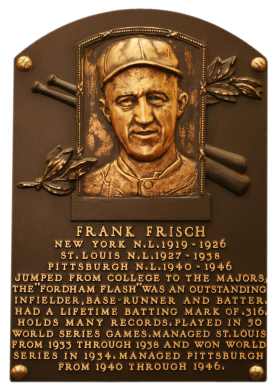
I remember my very first year, maybe the most outrageous hitting-out-of-turn moment, I mean, really. It was against the Cubs, Chicago Cubs, in Ebbets Field back in 1950. The manager of the Cubs was Frankie Frisch, the Hall of Famer.

Here's the one-oh pitch, Sandoval swings, fouls it, one and one.

Frisch went to Fordham. He was called the Fordham Flash. I went to Fordham. I was not called the Fordham Flash. And we both knew of each other's background, and I went in to get the lineup from the manager.

And he said — in those days, they had to fill out three cards. And he said, "Well, I already filled a card out. I gave it to Spud Johnson. He's out on the field."

I said, "Okay, Mr. Frisch, I'll go upstairs."

"No, no, no," he said. "Don't go away, I'll give you the lineup."

One-one pitch is swung on, lifted around second base. It's Mark Ellis waiting, and makes the catch for the second out.

So, Frankie Frisch gave me the lineup and printed out two cards. I went upstairs, and soon as the game started, I thought, "Oh my gosh, I have messed up. I've written the lineup down incorrectly."

And all during the game I was trying to correct my scorebook. It was a mess.

Ninth inning, bases loaded, two out. The Cubs are trailing the Dodgers by a run. And a left-hand hitter named Carmen Mauro came up to the plate. And I looked and I thought, Well he's been batting — I've made a mess out of my scorebook.

He promptly doubled in three runs to give the Cubs an approximate victory.

The pitch to Posey in for a strike.

And then Burt Shotton, the manager of the Dodgers, did not wear a uniform, so he was not allowed out on the field. His coach, you would call him a bench coach today, Clyde Sukeforth, came out and said, Carmen Mauro — who had just doubled in three runs — was hitting out of turn.

The guy who was supposed to be up was declared out, Mauro had a second at-bat, flied out, and the game was over.

Strike-one pitch, low and inside.

Things came out of the Chicago dugout that I didn't know were in there. Frankie Frisch just tore up the place.

You think that's bad, here's this kid broadcaster, had to go back and see Frisch the next day, and ask him for the lineup.

Yeah, that was an out-of-turn mess I will never forget. Although in all honesty, Frank didn't blame me, but I was part of the circumstances that led to it.

So, out of turn in the first inning, okay. Out of turn in the ninth with the bases loaded? Wow.

The pitch now to Buster Posey, swung on and missed, And the count one and two.

Two down, bottom of the first inning, no score. Hunter Pence on deck.

Kershaw, very deliberate, plants the left foot just about in the middle of the rubber. Posey, solid right-hand hitter, leader of the Giants. Buster waiting, and the one-two pitch on the way, and that's a change high, two-and-two the count.

There is one other thing you might wonder about. You know, the plate umpire gets the official lineup before the game, in the exchange of cards.

Well, what the umpire normally does, he puts the lineup in his pocket. But there's no rule that says the umpire, had he known, would have prevented him from saying to Posey, You're hitting out of turn.

Ground ball juggled by Ramirez, but they get a force play anyway. No runs, one hit and one left. And at the end of an inning, no score.

Tuesday, April 30, 2013

Ebbets Field Lives — in Postcards

42 is fresh in our minds, as is Ebbets Field. If you live in New York, you can relive some of the old-timey goodness. Thanks to BJ Killeen for the link: from "Winning pictures: B'klyn’s stars in postcard show" at the New York Post:

The Brooklyn Dodgers, who crushed the hearts of loyal city fans nearly 60 years ago by abandoning Ebbets Field for the bland riches of Los Angeles, will resurface in Manhattan next month — in classic postcards.

The unique historical presentation is being offered at The New Yorker hotel on West 34th Street, where visitors can view scores of postcards of the Boys of Summer and their former stadium, which opened 100 years ago this month.

"Bland riches of Los Angeles!" Guess old grudges die hard. We'll just enjoy being the new Yankees (and all the problems that entails).

photo courtesy of Hy Mariampolski

Monday, April 15, 2013

Tag Team Movie Review: 42

OREL: Mrs. Orel and I caught 42 this weekend. Reportedly budgeted at $40 million, the movie is already a success, earning $27.3 million so far, the highest-grossing opening weekend for a baseball movie. Audiences polled by CinemaScore gave it an A+; critically, it's at 75% "fresh" at Rotten Tomatoes and has a 63 Metacritic score.

So it feels sacrilegious to criticize a project so pure of heart — and on Jackie Robinson Day! — but the ghost of Roger Ebert just threatened to kick my ass if we didn't provide a balanced review. Really, we wanted to embrace this movie and were ready to flood the Regency Village with our tears. And while we left the theater with even more love and respect for Jackie, we left dry-eyed.

MRS. OREL: There are many favorable aspects to this film, starting with the performances of Chadwick Boseman as Jackie and Nicole Beharie as Rachel. Heartfelt, disciplined work from both. I also appreciated Christopher Meloni as Leo Durocher, Andre Holland as the journalist Wendell Smith and Toby Huss as the coach Clyde Sukeforth. Lucas Black as Pee Wee Reese is a pleasure and Alan Tudyk succeeds in conveying the awfulness of the reprehensible Phillies manager Ben Chapman.

O: Agreed, the supporting cast is uniformly excellent, including Hamish Linklater as Ralph Branca and John C. McGinley as Red Barber.On the other hand, SoSG hero Harrison Ford essays the role of Branch Rickey by chewing so much scenery you worry the Ebbets Field bleachers might cut his gums. Director Brian Helgeland has teased out Ford's eyebrows with extensions, given him a stogie to chomp on and allows his jaw to jut and lips to curl with abandon. It's fun to watch but it's caricature, eyewitness approval notwithstanding.

MO: Indeed, so much pixie dust is used that it requires major league squinting to find glimpses of reality. Mark Isham's score is cloying and derivative. Caroline Harris' costumes are crisp, as if freshly unpackaged. The vintage cars are assembly-line shiny and every hairdo is sleek and perfectly Brylcreemed.

O: However, Don Burgess' photography is magical in creating an on-field intimacy in the baseball scenes. The visual effects work and Richard Hoover's production design are excellent in re-creating Ebbets Field, Shibe Park in Philadelphia, Crosley Field in Cincinnati and Forbes Field in Pittsburgh. The baseball sound effects are crisp and lively. Count Basie's version of "Did You See Jackie Robinson Hit That Ball?" even makes an appearance, albeit over the end credits.

Jackie and Rachel remain essentially the same people at the film's end as they are at its beginning.

MO: But at the center of 42 is the difficult promise Rickey drafts out of Jackie Robinson. The surety that no matter what horrible invectives are thrown his way he must never, ever lose it. Never rise to defend, fight or seek revenge. This was Jackie's monumental courage. He did not break the promise. Who of us could do the same?

O: Ultimately, the movie's respect for its source material is its strength and weakness. The burden of both institutional and casual racism are effectively presented, with Tudyk's portrayal of Chapman especially biting. Indeed, the film makes liberal use of the N-word, and every utterance feels like a beanball to Jackie's soul. But the filmmakers are so careful of Jackie's legacy they've included only one scene (reportedly fictional at that) dealing head-on with Jackie's stress and anger at his gargantuan task.

MO: Similarly, the loving marriage of Jackie and Rachel, so crucial to this story, is soaked in sugar. Are we to believe they never buckled or chafed at the consequences of that impossible contract? We are left with a tiny scene of Rachel, teary and leaning on Jackie's shoulder, after he's been deliberately hit on the head by a pitch.

O: Without those touches of humanity, Jackie and Rachel remain essentially the same people at the film's end as they are at its beginning; they just land on a bigger stage. We learn more about the legend than the man. Because he was a pioneer doesn't mean he wasn't human. It's The Passion of the Baseball Christ.

MO: In my version of Hollywood, Magic Johnson produces sequels to this movie. He convinces Spike Lee, or Bennett Miller, or Steve McQueen, to direct, and we get to see Jackie in the 1955 World Series, Jackie navigating family life as his son is sent to Vietnam, and Jackie at the very end. But 42 is what we have now and I have to like it for what it tells the world about Jackie and Rachel Robinson.

O: As a historical document and educational tool, 42 is a resounding victory. As a testament to the Robinson family, it feels lacking.

MO: They deserve more.

Some random details I wanted to get off my chest:

  • In a scene at one of the minor league stadiums, I thought I saw plastic seats in the background. Wouldn't this have been an anachronism?
  • Speaking of nitpicking, "Baseball Writer's Association" in the epilogue? Two closed quotes around "42"? Where are the proofreaders at Warner Bros.? Back me up here, grammar geeks.
  • The film ends in 1947, meaning there's no Vin Scully in it. Which is kind of a bummer.
  • In researching Jackie, I was saddened to learn that Jackie's son, Jackie Jr., died in a car accident one year before Jackie himself died. It reminded me that Tommy Lasorda had a son, Tommy Jr., who died in 1991. And Vin's son, Michael, died in 1994. It turns out some major figures in Dodger history are connected by like tragedy.

UPDATE: One example of how 42 has made an impact, by former pitcher C.J. Nitkowski.

Saturday, April 06, 2013

Vin Scully Commemorates Ebbets Field's 100th Anniversary

Vin Scully, from last night's telecast:

It is exactly one hundred years ago today that Ebbets Field opened up in Brooklyn. Charles Ebbets built a ballpark in an area that was called Pigtown, and the real estate was pretty cheap, so he built the ballpark and the first game ever was played there a hundred years ago today.

Among other things, Casey Stengel, yes, the great manager, Casey Stengel played in that first game and not only hit a home run, but hit a home run inside the park.

And do you like music? To me, one of the saddest baseball songs I have ever heard — you like Frank Sinatra. Well Frank Sinatra recorded a song called "There Used to Be a Ballpark." And it was all about Ebbets Field. Wow. What a combination, Sinatra and Ebbets Field.

And with that, lets go back to this one.

Ah yes, there used to be a ballpark. But nothing is forever, that's for darn sure.

I was interviewed over the phone, and a writer was asking about Ebbets Field disappearing, and I told him a true story. I grew up in an area of New York called Washington Heights. Washington Heights, when I was growing up, a little boy, was probably ninety-five percent Jewish. Mostly Jewish refugees escaping Hitler.

Barmes a strike, oh and one.

Today, that same area is heavily Hispanic, and it has produced some terrific players, like Manny Ramirez.

That's foul down the line.

And in that neighborhood, believe it or not, as a little kid, maybe — it was all apartment houses, except about five blocks from where I lived, there was a castle. You say, What do you mean a castle? I mean a castle.

It was made of pure white Carrara marble and it was unbelievable. It looked out across the Hudson River at New Jersey, and on a summer's night, when the moon hit that castle, you just couldn't believe it.

However, the owner, Doctor Paterno, passed away. His sister sold it. Today there's maybe six or seven tall, towering apartment houses called Castle Village.

We bring that up because Ebbets Field is no longer and there are apartment houses where Ebbets Field stood.

Nothing is forever.

Two and two the count to Clint Barmes....

Thursday, April 19, 2012

Ebbets Field Blueprints to Go on Display in Brooklyn

Friday, April 06, 2012

Vin Scully, on Opening Day Mishaps

Vin Scully, from yesterday's game:

We are happy to say the pre-game ceremonies went off without a hitch. We bring that up because this is an anniversary of one of the most embarrassing moments, I think, in all of opening days for the major leagues.

The one-one pitch, swung on and missed, one and two.

Naturally, it involved the Dodgers, and naturally, it involved Ebbets Field in Brooklyn. Opening day in 1913. And they had a large band on the field. They all marched out to center field for the raising of the colors.

One ball and two strikes to Rivera, here comes Volquez and a high bouncer towards third, tough play for Headley, but he guns and gets him on that high hopper! Two down.

So the entire big band marched out to center field, all the players marched out to center field. All the city officials and the borough officials marched out to center field. And the owners of the Dodgers in center field for the raising of the flag.

And someone said, Okay, raise the flag.

And someone else said, What flag?

And he said, I thought you brought it.

No, I thought you—

So they had opening day in Ebbets Field, waiting for the colors, and the colors weren't there.

That I think is what you would call a rather embarrassing day, but it just adds to the history of the Dodgers.

With two down, James Loney at the plate....

Monday, April 04, 2011

Vin Scully, on Glove Lore

Vin Scully, from Friday's telecast:

...and he'll be facing Nate Schierholtz, and it's a little bit of a surprise, as Schierholtz takes a strike. Nate, when he first came up to the big leagues, was one of those rare players who never wore a batting glove. Well now, he wears two gloves, one on each hand.

Oh and two.

Batting gloves have been around a while. I can remember, when we were back in Brooklyn, I had a friend of mine named Danny Lawler, who was a golf pro, and he worked for Izod, you know the sporting goods company with the little alligator as a logo?

And Danny Lawler gave Bobby Thomson, of the New York Giants and of the famous home run, he gave Bobby a batting glove and said, "You oughta use these. Golf pros use a batting glove. They take the glove off when they putt, but otherwise they use a glove."

So Bobby would wear the batting glove, but he only wore it in batting practice and spring training. He wouldn't wear it during the game. Slowly and surely guys were wearing batting gloves, but only in batting practice.

Finally, and this is a guess, but it might have been Ken Harrelson, with the White Sox, back around '63, '64. Ken, I believe, might have been the first player to use a batting glove.

But it all goes back to Danny Lawler, an old pro who gave a glove to Bobby Thomson. 1949.

Here's Sandoval.

There are a couple of things that might amaze you in trying to think back. I was thinking the last couple of days, what's different. The batting glove is reasonably different. The helmet, in the fifties.

You know what might shock you? Until 1953, in that season, you know players left their gloves on the field? Did you know that?

Shot up the middle! Right between the legs of Guerrier and the tying run's aboard as Sandoval singles. [...]

You might say, "What do you mean, they left their gloves on the field?" Yeah, they did. If you were the third baseman or the first baseman, the inning would end, you'd throw your glove in foul ground. Shortstop, second baseman, they'd scale their gloves out into the shallow outfield area. The catcher and the pitcher would walk off with their glove. The outfielders would drop their gloves.

One and one.

And because players left their gloves, the other team used to do some mighty nasty tricks.

I know Phil Rizzuto, once, put a dead rat in the glove of the opposing shortstop. Oh yeah, they were full of that.

And I know one game at Ebbets Field, I don't know who the Dodger was, they put a small snake in the glove of the shortstop.

And they left gloves on the field until the end of 1953. And you know what? I don't ever remember of anything happening, where a game was lost, somebody stepped on a glove, slipped or whatever, nope.

One and one....

photo from Studio 1050...

Wednesday, June 09, 2010

Vin Scully, on Casey Stengel

Vin Scully, from Sunday's telecast:

...there couldn't have been too many laughs. The country was at war, but on this date in 1918, Casey Stengel was coming to the plate at Ebbets Field.

Now he had played for the Dodgers for six years, then he was traded away to Pittsburgh, and now he came back. He was always popular. Crowd gave him an ovation. Casey got in the box, then he backed out and asked for time.

Time was granted. Casey turned to the crowd, took off his cap, and a bird was on his head and flew away.

One of the more memorable moments, they tell me, in baseball played anywhere.

He was something. Let's go back to this one.

Four-four in the sixth inning, and by the way, Casey went from being a so-called clown, a fellow who had studied to be a left-handed dentist — yeah that's right, left-handed dentist — anyway, Casey in his twenty-five year managerial career won ten pennants, seven World Championships.

So four-four, Justin Miller, and a ground foul off the bat of Melky Cabrera....

Stengel re-creates his stunt at a Brooklyn/Los Angeles Old-Timers Game at Dodger Stadium.

photo from Blue Heaven